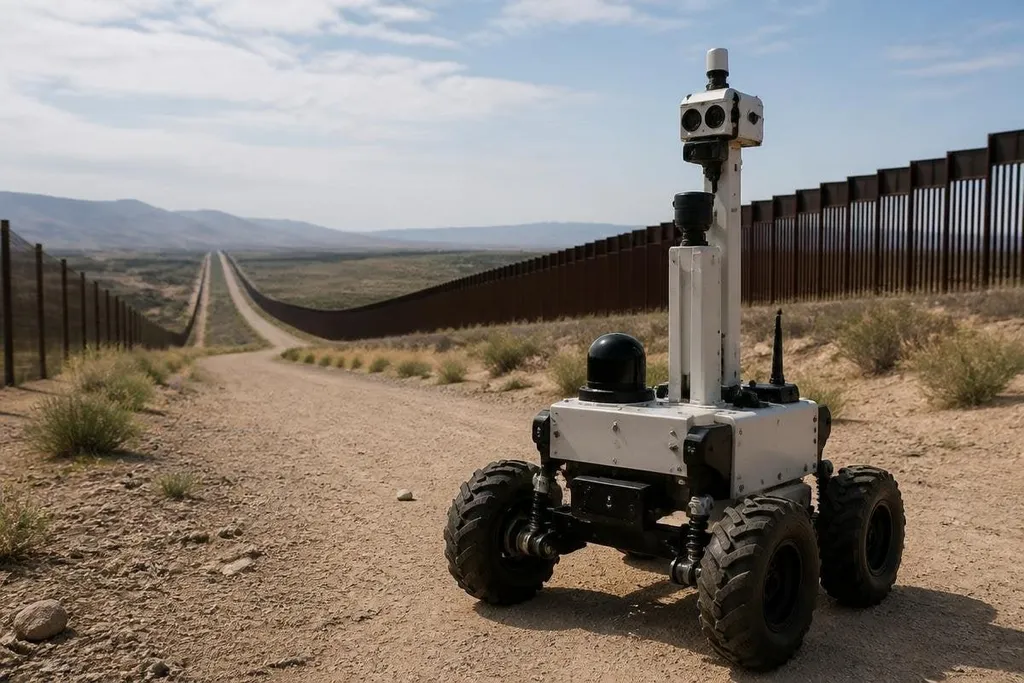
A border robot may watch a remote route for hours, but a camera feed alone doesn’t make a safe security system. The next wave will need to detect people, explain alerts, handle bad weather, and work under strict human control.
The source material for this article includes no product tests, deployment reports, prices, or named systems. That limits the claims we can make about current machines, so the useful question is what a serious border robot should prove before anyone buys it.
- A sensor can spot movement without knowing who or what caused it.
- Remote supervision matters when the robot reaches a blocked route or loses its signal.
- A field trial should measure false alerts, battery time, recovery, and operator workload.
The sensors have to work together
A patrol robot may carry visible-light cameras, thermal cameras, LiDAR, or radar. Each sensor sees a different part of the scene: a normal camera needs light, thermal imaging reads heat, and LiDAR measures distance with laser pulses.
One sensor can raise an alert, but the system should compare several inputs before it asks a person to act. A plastic sheet moving in wind, an animal near a fence, and a person crossing open ground can look similar in a single video stream.
That check also needs a record. The system should save the image, time, location, sensor input, and reason for the alert, with access limited to approved staff. Without that record, an operator can’t review a false alert or explain a decision later.
Autonomy stops at the right point
An autonomous robot can follow a route and flag changes without someone steering it every second. It still needs a person to decide what an alert means and what action should follow.
The handoff should be clear. An operator needs the robot’s location, the sensor view, the age of the alert, and the reason for the warning on one screen.
If the network drops, the robot should stop, return to a safe point, or follow a pre-set route. The chosen response must be tested before field use.
Remote control brings its own risk. A delayed video feed can make a robot appear closer to an obstacle than it is, while a weak signal can leave the operator unable to stop movement. These are system faults, not small software details.
Those faults matter most when a border robot works far from its operator and a mistake can affect a person’s safety or legal status. Robot24 can tie claims about these systems to the robot, control link, test site, date, and human role before the field test asks what survives outside a demo.
The field is harder than the demo
A controlled demonstration says little about long patrols. Rain can cover a lens. Dust can reduce sensor quality. Uneven ground can drain a battery faster than a flat test route, and a fence or narrow path can block the robot’s normal route.
A sound trial should include night work, poor weather, lost communications, blocked paths, and false alerts caused by animals. It should also measure how many hours an operator must watch the system and how often staff need to recover the robot.
The missing evidence matters. No deployment count, detection rate, battery result, price, or independent test was supplied here, so no honest article can rank a current border robot or claim that one is ready for broad use.
I’d reject any purchase based on patrol footage alone.
Checks before a purchase
Use this list when a vendor presents a border robot for review:
- Ask for the exact model, software version, sensors, weight, battery time, and operating temperature.
- Request field results that separate people, animals, vehicles, and moving vegetation.
- Check how the robot behaves after a lost signal, blocked route, low battery, or sensor fault.
- Measure false alerts per patrol hour and the time needed for a person to review each one.
- Confirm who can access stored video, how long it stays on the system, and how staff delete it.
- Set a stop rule for the trial before the robot enters a public operating area.
Those checks turn a polished demonstration into a test that another team can repeat. They also show where a robot helps and where trained staff still carry the decision.
The next useful evidence is a dated field report with route length, weather, alert counts, battery time, recovery events, and operator hours. Until those numbers exist for a named system, border security robots remain proposals to test, not patrol tools to trust.